
ESNNA CERTIFICATION & CODE OF CONDUCT
ANNEX I
CODE OF CONDUCT AGAINST THE SEXUAL EXPLOITATION OF GIRLS, BOYS AND ADOLESCENTS (ESNNA) IN THE FIELD OF TOURISM, FOR TOURISM SERVICE PROVIDERS
PREAMBLE
The Ministry of Foreign Trade and Tourism (MINCETUR) is the governing body for tourism, responsible for promoting, guiding, and regulating it in order to foster its sustainable development.
Law No. 29408, the General Tourism Law, establishes in Article 3 the principles of tourism that must be applied by public administration entities and tourism service providers.
In accordance with Article 44 of the aforementioned Law, MINCETUR has the authority to coordinate, formulate, and propose the issuance of regulations required to prevent and combat the Commercial Sexual Exploitation of Children and Adolescents (ESNNA) in the tourism sector. It also develops and implements, in coordination with the Ministry of Women and Vulnerable Populations and other relevant sectors, national programs and projects related to this issue.
The same article states that regional and local governments have the obligation to adopt measures to prevent ESNNA in the tourism sector within their respective territorial jurisdictions.
In this context, Article 41 of the Regulations of the General Tourism Law, approved by Supreme Decree No. 003-2010-MINCETUR, establishes that among the actions that regional governments may adopt to prevent the sexual exploitation of children and adolescents (ESNNA) is the signing of commitments or codes of conduct by tourism service providers and other stakeholders in the tourism sector.
In this regard, it is important to note that the provision of tourism services is a key component for the development of tourism products and destinations. Accordingly, Article 43 of the General Tourism Law establishes the responsibility of service providers to communicate, disseminate, and publish the existence of regulations on the prevention and punishment of ESNNA in the tourism sector.
Therefore, it is necessary to establish a set of principles, behaviors, and practices to prevent and combat ESNNA in the tourism sector, in order to contribute to the sustainable tourism development of Peru.
Therefore, the principles developed in the Code of Conduct against the Sexual Exploitation of Children and Adolescents in the field of tourism are established for tourism service providers, referring particularly to the legal instruments listed below:
Law No. 30802, Law establishing conditions for the admission of children and adolescents to lodging establishments in order to guarantee their protection and integrity.
Law No. 30362, Law elevating Supreme Decree No. 001-2012-MIMP to the status of law and declaring the allocation of resources a matter of national interest and a priority.
ANNEX I
Public regulations to guarantee compliance with the National Action Plan for Children and Adolescents (PNAIA) 2012-2021.
Law No. 29408, General Tourism Law.
Law No. 28868, Law that empowers MINCETUR to define infractions by regulation regarding the provision of tourist services and the classification of lodging establishments and establishes the applicable sanctions.
Law No. 27337, which approves the New Code for Children and Adolescents.
Supreme Decree No. 001-2012-MIMP, which approves the “National Action Plan for Children and Adolescents – PNAIA 2012-2021” and establishes the Multisectoral Commission in charge of its implementation.
Supreme Decree No. 003-2010-MINCETUR, which approves the Regulations of the General Tourism Law.
Convention on the Rights of the Child. Approved as an International Human Rights Treaty.
World Tourism Organization Global Code of Ethics for Tourism. Approved by the General Assembly of the World Tourism Organization.
OBJECTIVE
The Code of Conduct aims to establish the foundations of responsible behavior, as well as reaffirm the principles, duties, and general standards that tourism service providers and their employees must know and comply with in order to prevent the sexual exploitation of children and adolescents (ESNNA) in the performance of their activities.
In this context, it seeks to promote the commitment of the private sector to combat the crime of sexual exploitation of minors, within the framework of the National Policy on Mandatory Compliance for the Protection of Children and Adolescents.SCOPE
This Code is applicable to tourism service providers included within Annex No. 1 of “Law No. 29408 – General Tourism Law”.
III. PRINCIPLES
3.1 The Best Interests of Children and Adolescents Children and adolescents are full subjects of rights that must be respected by the family, the State, and society. This principle obliges the State and society to recognize and guarantee the human rights of children and adolescents and gives precedence to the best interests of children and adolescents over other interests and considerations (National Action Plan for Children and Adolescents 2012-2021 – Ministry of Women and Vulnerable Populations).
3.2 Children and Adolescents as Subjects of Rights This principle highlights the status of children and adolescents as complete and respected human beings, possessing potential to be developed and holders of civil, political, economic, social, and cultural rights that must be recognized simply by virtue of their existence. In this sense, children and adolescents are not considered incapable, as established in the National Action Plan for Children and Adolescents.
3.3 Sustainable Tourism Development Tourism activity must improve the quality of life of local populations and strengthen their social, cultural, and economic development, under equal conditions. Therefore, for tourism to be sustainable, it needs to respect the environment, our culture, and human rights, especially those of children and adolescents. For this reason, we promote the enjoyment of positive exchanges between tourists and visitors, based on respect and equity.
DUTIES
The tourism service provider is obligated to comply with the duties established in Law 29408 – General Tourism Law and its Regulations approved by Supreme Decree No. 003-2010-MINCETUR; as well as those duties established in Law No. 30802 – Law that establishes conditions for the entry of children and adolescents into lodging establishments in order to guarantee their protection and integrity, paying special attention to:
a) Maintaining an ethical policy of rejection towards the sexual exploitation of children and adolescents (ESNNA) in the tourism sector, in order to protect children and adolescents from all forms of sexual exploitation perpetrated by national or foreign tourists, other tourism service providers, and any other person.
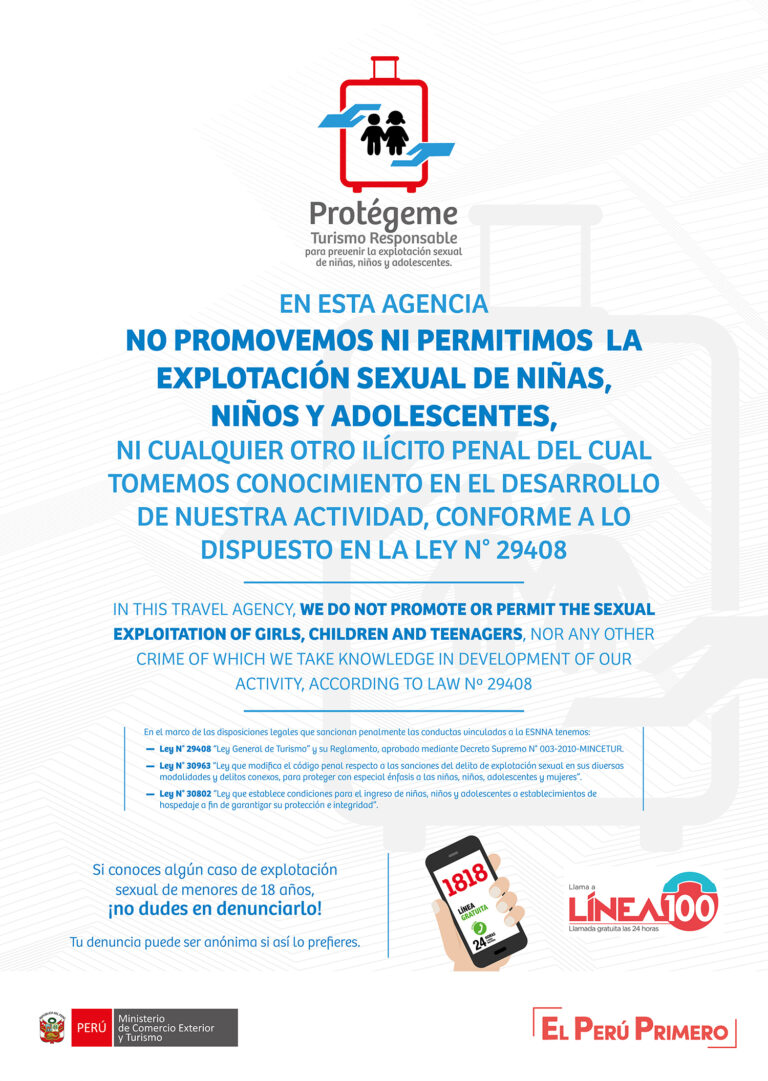
b) No tourism service provider shall promote or permit the sexual exploitation of children and adolescents (ESNNA) in their establishments.
c) Not to promote or permit the entry of children and adolescents into the rooms or apartments of lodging establishments without the company of one or both parents, guardian, or responsible party, duly accredited by the competent authority or with documentation demonstrating the judicial or legal relationship between them, or, failing that, with written authorization and a signature legalized by a notary public. This must be in accordance with the requirements for guest admission established in the Regulations for Lodging Establishments or the provision that replaces them.
d) To immediately report to the competent authority any act related to the sexual exploitation of children and adolescents (ESNNA) or any other criminal offense of which they become aware in the course of their work.
e) To inform and train staff on the company’s policy regarding the prevention of ESNNA in the tourism sector.
f) Refrain from offering, explicitly or implicitly, in tourism promotion programs and tourism plans, situations related to the sexual exploitation of children and adolescents (ESNNA), and refrain from directing tourists, either directly or through third parties, to establishments or places where ESNNA is practiced.
g) Display in a visible location in their establishment the informational material on the prevention of ESNNA, designed by MINCETUR in accordance with the provisions of the Third Final Complementary Provision of Law No. 30802, Law that establishes conditions for the entry of children and adolescents into lodging establishments in order to guarantee their protection and integrity.
h) Submit an annual report detailing the actions taken within the framework of the prevention of the sexual exploitation of children and adolescents (ESNNA). This information must be sent to the offices of the Regional Management of Foreign Trade and Tourism – GERCETUR or the Regional Directorate of Foreign Trade and Tourism – DIRCETUR of the corresponding Regional Government; and in the area of Metropolitan Lima, to MINCETUR, via email: prevencionesnna@mincetur.gob.pe.DISSEMINATION, SUBSCRIPTION AND MONITORING
5.1 DISSEMINATION
The tourism service provider must disseminate the laws, regulations, internal provisions, manuals, and other information it deems relevant regarding the prevention of the sexual exploitation of children and adolescents (ESNNA) among its employees, in accordance with Article 43 of the Regulations of the General Tourism Law approved by Supreme Decree No. 003-2010-MINCETUR. Likewise, it will inform its staff and suppliers or contractors of the obligation to comply with the policies contained in this document, in order to prevent ESNNA in the tourism sector.
5.2 SUBSCRIPTION
The Regional Governments, through the corresponding DIRCETUR or GERCETUR, will manage the subscription of the Code of Conduct by all tourism service providers, which will be accredited with the signature of the Mandatory Subscription Affidavit, approved by MINCETUR.
5.3 MONITORING
The monitoring of compliance with the duties of this Code will be the responsibility of the GERCETUR or DIRCETUR at the regional level; and in the Lima Metropolitan area, the responsibility of the General Directorate of Tourism Development Policies of MINCETUR.
NON-COMPLIANCE
Failure to comply with the provisions of this Code will be sanctioned administratively, as appropriate, in accordance with current legal regulations. Any administrative sanctions that may be applied do not exempt the tourism service provider from any criminal liability that may arise, as established in the Peruvian Penal Code.